


1. The Busy Trap
You know the feeling: you’re running all day, answering emails, reacting to messages, putting out fires… but then you look up and wonder, Did I actually move anything important forward? Have I prioritized urgent vs important tasks?
This is the trap so many of us fall into.
We confuse what’s loud with what matters.
But there’s a better way. Today, I’m giving you a framework that helps you focus your time on what actually counts—so you can stop reacting and start leading.
And when you find yourself overwhelmed? You’ll have the tools to “dump it all out,” sort your tasks, and get your calendar back into alignment with your priorities.
Let’s jump in.
2. The Big Misunderstanding: Urgency Isn’t Importance
Before we can prioritize well, we need clarity.
Urgent
Urgent means it needs attention now. It has a real due date or consequence attached to it. A customer outage, a shipment missed, a warehouse literally on fire—those are urgent.
But here’s a common myth:
Just because someone senior asks a question doesn’t make it urgent.
“The board asked!”
“The president emailed!”
Great. But unless there’s a real deadline, it’s not urgent.
And often? A deadline isn’t even given. That’s your cue to clarify.
Important
Important means it is valuable and aligned to goals, mission, and growth.
But here’s the second myth:
Important does NOT automatically mean you should be the one doing it.
We confuse “important” with “mine.”
Some work may be extremely important—but the highest value person to do it is someone else on the team.
Great leaders know the difference.
3. Introducing the Eisenhower Matrix (Made Practical)
Enter the classic productivity tool: the Eisenhower Matrix.
Visualize a simple 2×2 square:
- One axis: Urgent ↔ Not Urgent
- The other: Important ↔ Not Important
Matrix Example:
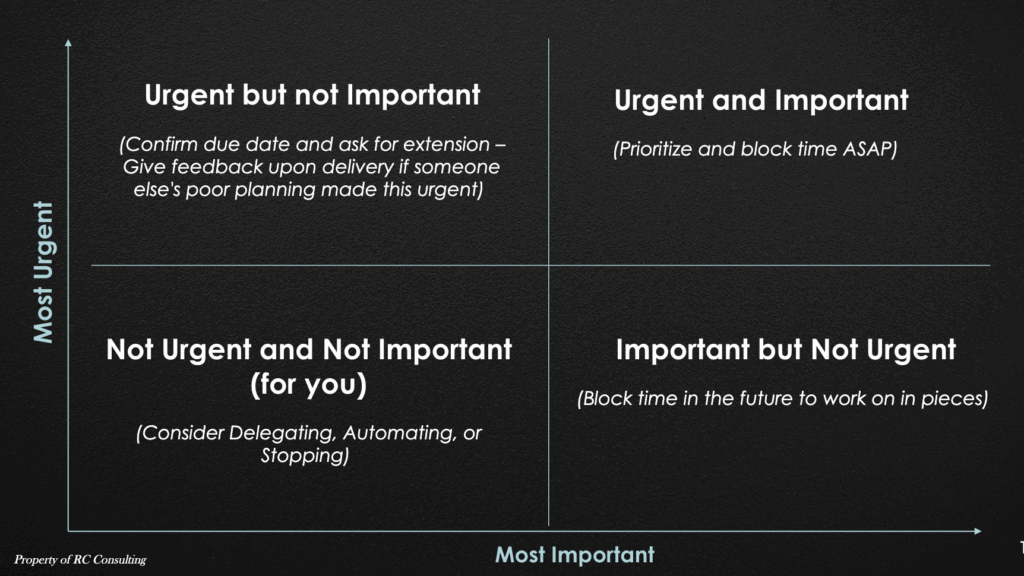
Every task you have belongs in one of these boxes.
And once you learn to categorize with honesty, your priorities become clear.
Let’s break down each quadrant—along with the traps and tips that help you stay aligned.
4. Quadrant 1: Urgent and Important
These are your true emergencies and mission-critical tasks:
Crises, customer issues, critical deadlines, milestones requiring your direct insight or oversight.
These require action now.
Trap:
It’s easy to shove everything into this box. When everything feels urgent and important, nothing actually is.
Ask yourself: Is this truly urgent? And is it truly important for me?
Tip:
When something belongs in this quadrant, block your calendar and give it focused attention.
Then—keep reviewing this box and move work out as it stabilizes.
If you live here permanently, burnout will follow.
5. Quadrant 2: Important but Not Urgent
This quadrant is leadership gold.
This is where strategy, development, relationships, creativity, and growth live.
The work here is priceless—but quiet.
Trap:
We push this work to “later.”
But later never comes. And suddenly:
- You don’t have a strategy.
- Your team isn’t growing.
- Your skills are outdated.
This happens one delayed hour at a time.
Tip:
Block time in advance.
Don’t expect strategy or deep thinking to show up magically in the margins of your day.
I personally block three full days every December for reflection and planning. Why? Because this work deserves space.
Plan for it. Protect it. Prioritize it.
6. Quadrant 3: Urgent but Not Important
This is someone else’s last-minute scramble—the faux emergencies that suddenly land on your desk marked “URGENT.”
These aren’t aligned to your highest-value work, but sometimes you still must address them.
Trap:
You do the work, get frustrated… and then move on without giving feedback.
Which guarantees the same situation will happen again.
And again.
And again.
Their lack of planning becomes your emergency—because you allowed the cycle to continue.
Tip:
Do the post-mortem.
Explain the impact.
Pass the feedback.
People often don’t realize that their delay caused ripple effects downstream.
Invest the time now to prevent the next unnecessary fire drill.
7. Quadrant 4: Not Urgent and Not Important
This is the deceptively hard one.
These tasks feel harmless—maybe even comforting because you’ve always done them.
These often look and smell a lot like busy work. While we all say we hate busy work, we often enjoy the feeling of getting something done. Tasks that make us feel productive, but don’t actually produce anything.
Insight:
This isn’t laziness.
It’s comfort.
It’s avoiding the harder, more strategic work that requires courage, clarity, or risk.
Its believing it’s too much work to train someone else and that doing it ourselves is easiest.
Challenge:
Stop doing these tasks entirely.
Or automate. Or delegate. But they cannot stay on your plate in the long run.
Trap:
We love the feeling of checking a box—so we keep doing work that doesn’t belong to us.
We see it in others:
- The VP booking team travel
- The Director micromanaging weekly updates
- The senior leader reviewing every expense report
But if we’re honest?
We all have “tasks” that have camped out on our to-do lists far too long.
When I led a large team the hardest strategic question to answer was “what are we going to stop doing?” but it ended up being the most critical.
Tip:
Ask yourself:
- “Is there someone else who should own this?”
- “Is there technology that could automate this?”
- “Should this work stop altogether?”
Then act on the answer.
8. The Real Test: Ask the Right Questions
Curiosity is your secret leadership advantage.
Before placing a task in any quadrant, pause and ask:
- What’s the real deadline here?
- If I don’t do this today, what actually happens?
- Is this the most valuable work I can be doing right now?
- Who is the right person to own this work—and how do I get it in their hands?
And remember:
Sometimes urgency is borrowed anxiety—someone else’s stress landing in your inbox.
Give it back.
9. Your Daily Prioritization Practice
When you or your team feel overwhelmed, this is your way out.
Dump everything—tasks, meetings, goals—onto a blank sheet.
Sort each item into the quadrants.
Then ask:
- What traps am I falling into?
- What tips can move this work to the right place?
Create a plan to realign your calendar with your priorities.
Clarify deadlines. Move work to the right owner. And yes—stop the work that no longer adds value.
This is how you regain control.
10. Conclusion: Productivity = Purpose
At its core, productivity isn’t about doing more.
It’s about doing what matters most.
When you stop treating everything as urgent, you finally make space for the important.
So here’s your challenge:
This week, cross one “not important” task off your list—and watch your focus expand.